
You wake up and the first thought that enters your mind is, “I’m so tired. I don’t want to go to work.” As you get out of bed, you stub your toe.
You head to the kitchen and realize you are out of coffee. On your commute, you hit every red light. It feels like the universe is conspiring against you. Sound familiar?
Now, consider the opposite. You wake up feeling grateful for a good night’s sleep. Your first thought is, “Today is going to be a great day.”
Your morning flows smoothly. The commute is easy. You get a compliment from a coworker. Everything just seems to click into place.
While we often chalk these experiences up to “good days” and “bad days,” the Law of Attraction philosophy suggests something more deliberate is at play. It posits that our thoughts are not just idle chatter inside our heads; they are powerful creative forces that actively shape the reality we experience.
But how can a simple thought influence the physical world? Is it magic? Or is there a grounded explanation for this phenomenon? This guide will dive deep into the role of Law of Attraction thoughts, exploring how they work, why they are so powerful, and practical ways you can start using your mind to consciously build the life you desire.
The Nature of Thought: More Than Just Mental Chatter
At its core, the Law of Attraction is built on the premise that everything is energy. From a scientific perspective, we know that thoughts are not just abstract concepts. They are measurable electrical impulses that travel through neural pathways in our brain. Each thought generates a tiny but real energetic charge.
Think of your mind as a garden. Every thought you plant is a seed.
- Positive, empowering thoughts are seeds for beautiful flowers and nourishing fruits.
- Negative, limiting thoughts are seeds for weeds and thorns.
The garden of your life will grow according to the seeds you plant most consistently. A single negative thought won’t ruin your garden, just as a single weed won’t destroy a farm. But if you consistently plant seeds of doubt, worry, and fear, you cannot expect to harvest a life of joy, abundance, and peace.
Conscious vs. Subconscious Thoughts
To truly understand how thoughts shape reality, we must distinguish between the two levels of your mind.
- The Conscious Mind: This is your thinking, reasoning mind. It’s the part you are using to read and process these words. It represents about 5% of your mental activity.
- The Subconscious Mind: This is the vast, powerful database that runs in the background. It stores all your memories, habits, and deeply ingrained beliefs. It accounts for the other 95% of your mental activity.
Many people try to practice the Law of Attraction using only their conscious mind. They repeat positive affirmations, but their subconscious mind, holding onto old beliefs like “I’m not good enough” or “Life is a struggle,” cancels out the effort. It’s like trying to sail east while a powerful underwater current is pulling you west.
Therefore, the real work of harnessing your thoughts lies in aligning your conscious desires with your subconscious programming.
How Thoughts Create Your Reality: The Psychological Mechanisms
While the Law of Attraction is often discussed in spiritual terms, its effects are powerfully explained by well-documented psychological principles. You don’t need to believe in cosmic energy to see how your thoughts create your life.
1. The Reticular Activating System (RAS)
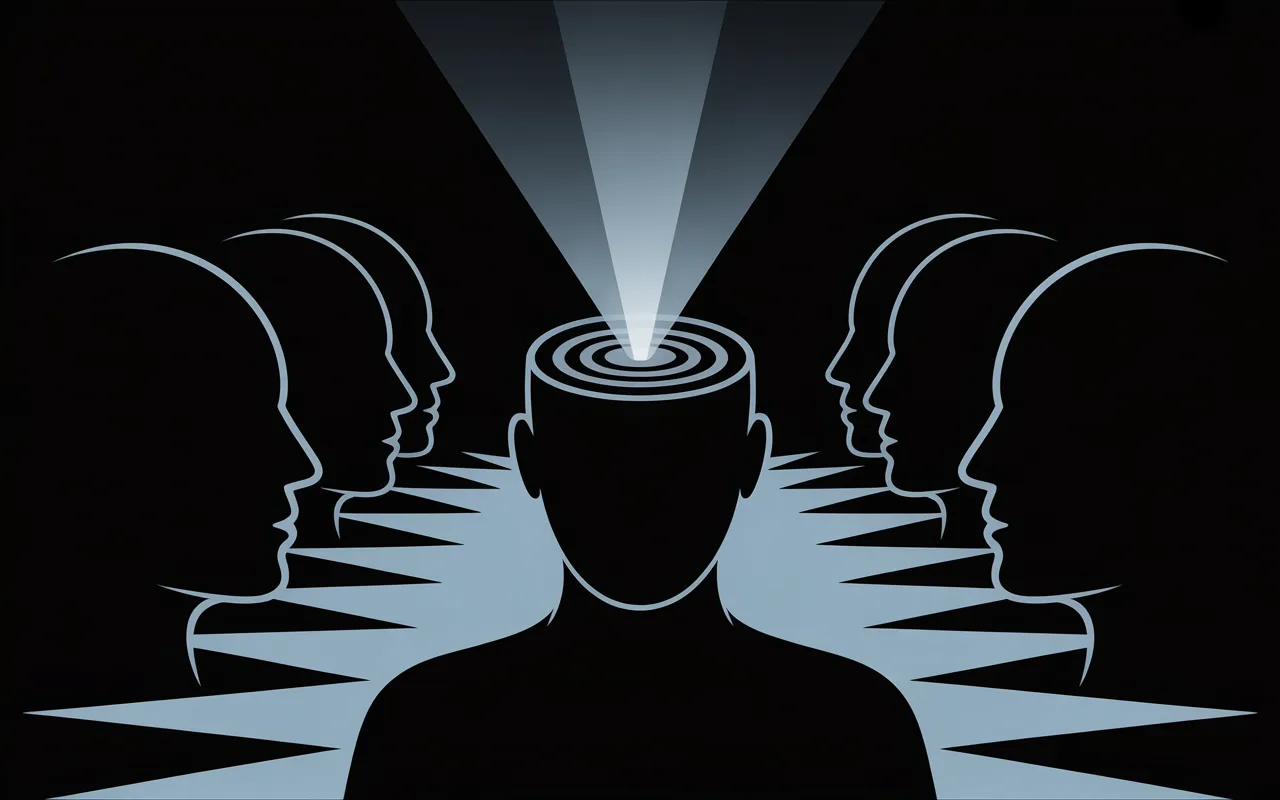
Your brain is constantly flooded with information. The Reticular Activating System (RAS), located in your brainstem, acts as a filter, deciding what gets through to your conscious awareness. Crucially, your RAS takes its orders from you—it prioritizes whatever you consistently focus on.
When you deliberately choose your thoughts, you are programming your RAS.
- If you consistently think, “I need to find a way to make more money,” your RAS will start highlighting opportunities you previously ignored—a “help wanted” sign, a conversation about a side hustle, an article about investing.
- If you consistently think, “People are untrustworthy,” your RAS will point out every instance that proves you right, while filtering out acts of kindness and integrity.
Your thoughts literally change what you are capable of seeing in the world around you. The opportunities were always there; your thinking patterns made them visible.
2. The Power of Confirmation Bias
Confirmation bias is our brain’s natural tendency to seek out and favor information that confirms what we already believe. Your brain loves to be right.
- If you believe you are “unlucky,” your brain will meticulously catalogue every instance of bad luck while dismissing fortunate events as flukes.
- If you consciously cultivate the thought, “I am a lucky person,” your brain will start to build a case for that belief, noticing synchronicities and small wins.
This creates a powerful feedback loop. Your thoughts shape your beliefs, and your beliefs dictate what evidence your brain collects from reality, which in turn reinforces your thoughts.
3. The Self-Fulfilling Prophecy
Your thoughts directly influence your actions, which in turn influence your results. This is the mechanism of a self-fulfilling prophecy.
- Negative Example: A person thinks, “I’m terrible at job interviews.” Because of this thought, they enter the interview feeling anxious. They avoid eye contact, speak hesitantly, and fail to project confidence. The interviewer reads this behavior as incompetence and doesn’t offer them the job, “proving” the original thought.
- Positive Example: A person cultivates the thought, “I am confident and capable.” They enter the interview with good posture, a firm handshake, and clear communication. This behavior impresses the interviewer, who offers them the job, validating the thought.
The practice of “acting as if,” popular in Law of Attraction teachings, is a conscious method for creating a positive self-fulfilling prophecy. You choose the thought, which alters your behavior, which produces a different result.
The Thought-Feeling-Action Loop
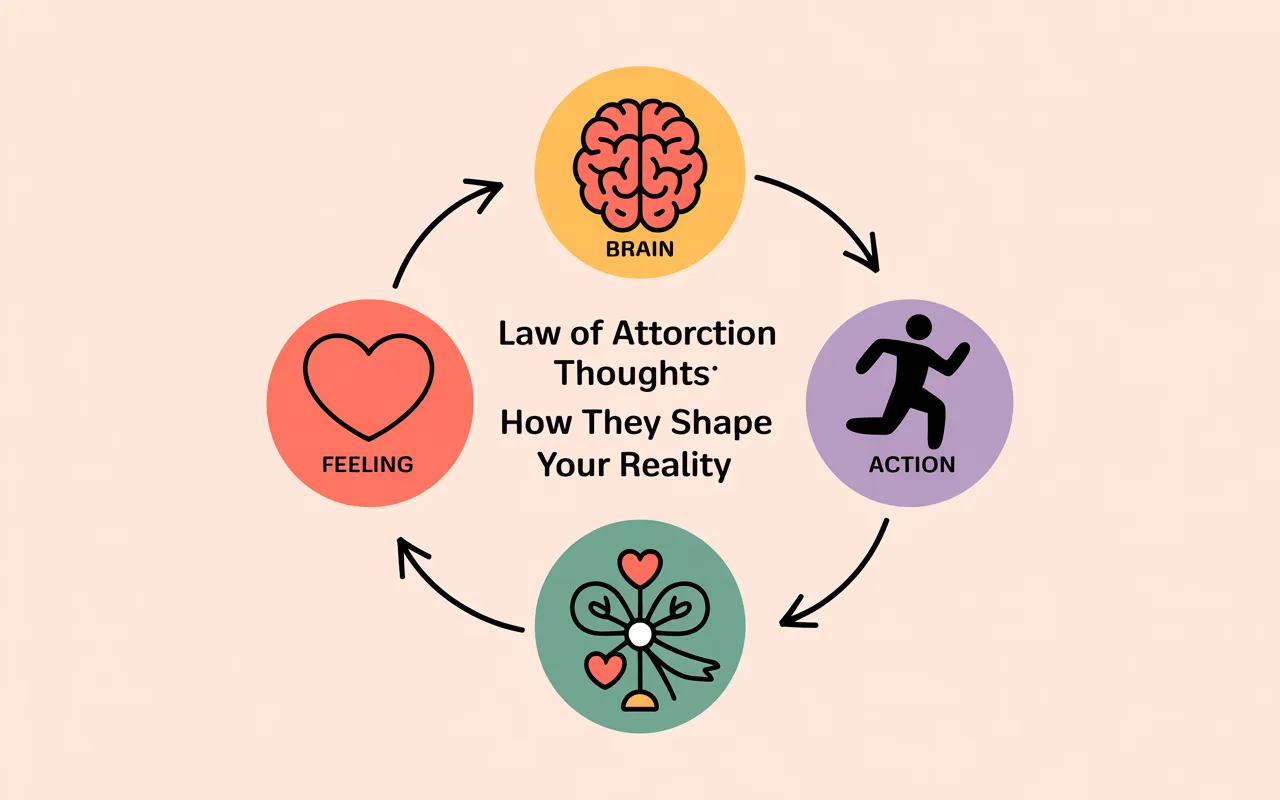
Thoughts alone are just the spark. It’s when they are combined with emotion that they become a powerful magnetic force. This is the thought-feeling-action loop.
- Thought: You have a thought (“I can start my own business”).
- Feeling: This thought triggers an emotion (excitement, passion). This emotion is the fuel. It’s the vibration that the Law of Attraction responds to.
- Action: The feeling of excitement motivates you to take inspired action (researching a business plan, registering a domain name).
- Result: Your action produces a result (your business starts to take shape), which reinforces your original thought.
If any part of this loop is broken, manifestation stalls. You can have a positive thought, but if it triggers a feeling of fear (“What if I fail?”), the low-vibration emotion will lead to inaction or self-sabotage. This is why mastering your thoughts isn’t just about “thinking positive”; it’s about learning to choose thoughts that generate empowering feelings.
Practical Techniques for Mastering Your Thoughts
Understanding the theory is the first step. The real change comes from applying it. Here are practical, effective techniques to start harnessing the creative power of your thoughts.
1. The Practice of Mindfulness (Becoming the Observer)
You cannot change thoughts that you are not aware of. Most of our 60,000+ thoughts per day are repetitive and subconscious. Mindfulness is the practice of stepping back and observing your thoughts without judgment.
- How to do it: Set aside five minutes a day to sit quietly. Pay attention to your breath. When a thought arises, simply label it (“thinking”) and let it float by like a cloud.
- The Benefit: This practice creates a space between you and your thoughts. You realize you are not your thoughts; you are the awareness behind them. This gives you the power to choose which thoughts to engage with and which to let go of.
2. The Art of the Pivot (Choosing a Better-Feeling Thought)
You will have negative thoughts. That’s part of being human. The key is not to dwell on them. The “pivot” is a technique for consciously redirecting your focus.
- Step 1: Acknowledge the Thought. “I’m feeling really anxious about this presentation.” Don’t resist or judge it.
- Step 2: Identify What You Don’t Want. “I don’t want to feel anxious and unprepared.”
- Step 3: Identify What You DO Want. “I want to feel confident, calm, and well-prepared.”
- Step 4: Reach for a Better-Feeling Thought. Don’t try to jump straight to “I am the world’s greatest speaker.” It’s too big a leap. Reach for something believable, like: “I have prepared for this,” or “I know more about this topic than most people in the room,” or even just “This will be over in an hour.”
Each pivot is a small course correction that guides your energy toward a more positive destination.
3. Deliberate Scripting
Scripting is a powerful way to impress your desired reality upon your subconscious mind. It involves writing about your goals in the past or present tense, as if they have already happened.
- How to do it: Get a notebook and write a journal entry dated six months or a year in the future. Describe your life in vivid detail. Don’t just list your accomplishments; focus on how you feel.
- Example: “It is December 2026, and I am sitting in my new home office, looking out at the snow. I feel so proud and grateful for the success of my online business. Waking up every day excited to work on something I built myself is the most incredible feeling.”
- The Benefit: This process helps you clarify your desires and generates the positive emotions necessary to attract them. It’s a mental rehearsal that makes your goals feel more real and achievable.
4. Creating Powerful Affirmations
Affirmations are positive statements designed to reprogram limiting beliefs. To be effective, they must be crafted correctly.
- Use Present Tense: “I am confident” is more powerful than “I will be confident.”
- Be Positive: Focus on what you want, not what you don’t want. “I am financially free” is better than “I am out of debt.”
- Add Emotion: “I am so happy and grateful now that money flows to me easily and abundantly.”
- The Key: Repetition is crucial. Say them in the morning, at night, and whenever you catch a negative thought. Write them on sticky notes and place them where you will see them often.

Navigating Common Thought-Related Challenges
As you begin to work with your thoughts, you will inevitably encounter some common hurdles.
“What if I have a bad day?”
Having a day filled with negative thoughts will not undo all your progress. The Law of Attraction responds to your dominant vibration. A single bad day is like one rainy day in an otherwise sunny month. Acknowledge it, be kind to yourself, and know that you can start fresh tomorrow. The goal is progress, not perfection.
“How do I stop overthinking?”
Overthinking is often a symptom of fear and a need for control. The best antidote is to get out of your head and into your body. Go for a run, take a dance class, or do some gardening. Physical activity quiets the analytical mind and helps release stuck energy. Mindfulness practice also trains the “monkey mind” to settle down over time.
“My thoughts are positive, but I still feel bad. Why?”
This is a classic sign of a conflict between your conscious thoughts and your subconscious beliefs. Your words are positive, but your body, which holds your emotional truth, knows you don’t believe them. This is a signal that you need to do deeper work on identifying and releasing the limiting belief that is causing the emotional discord.
Conclusion: You Are the Author of Your Story
Your thoughts are the pen with which you write the story of your life. For many of us, that pen has been writing on autopilot, scribbling down old stories of fear, limitation, and doubt learned from our past.
The practice of harnessing the Law of Attraction is about taking conscious control of that pen. It is the realization that you have the power to edit your story at any moment. You can cross out the chapters that no longer serve you and begin writing a new one, filled with purpose, joy, and empowerment.
This is not a passive process of wishful thinking. It is an active, daily practice of choosing your focus, managing your emotions, and aligning your actions with your intentions.
Start today. Begin by simply observing your thoughts. Notice the stories you tell yourself. Then, make a conscious choice to tell a better one. That single choice, repeated over time, is the most powerful creative force in the universe. Your reality is waiting for you to write it. What will the next sentence be?