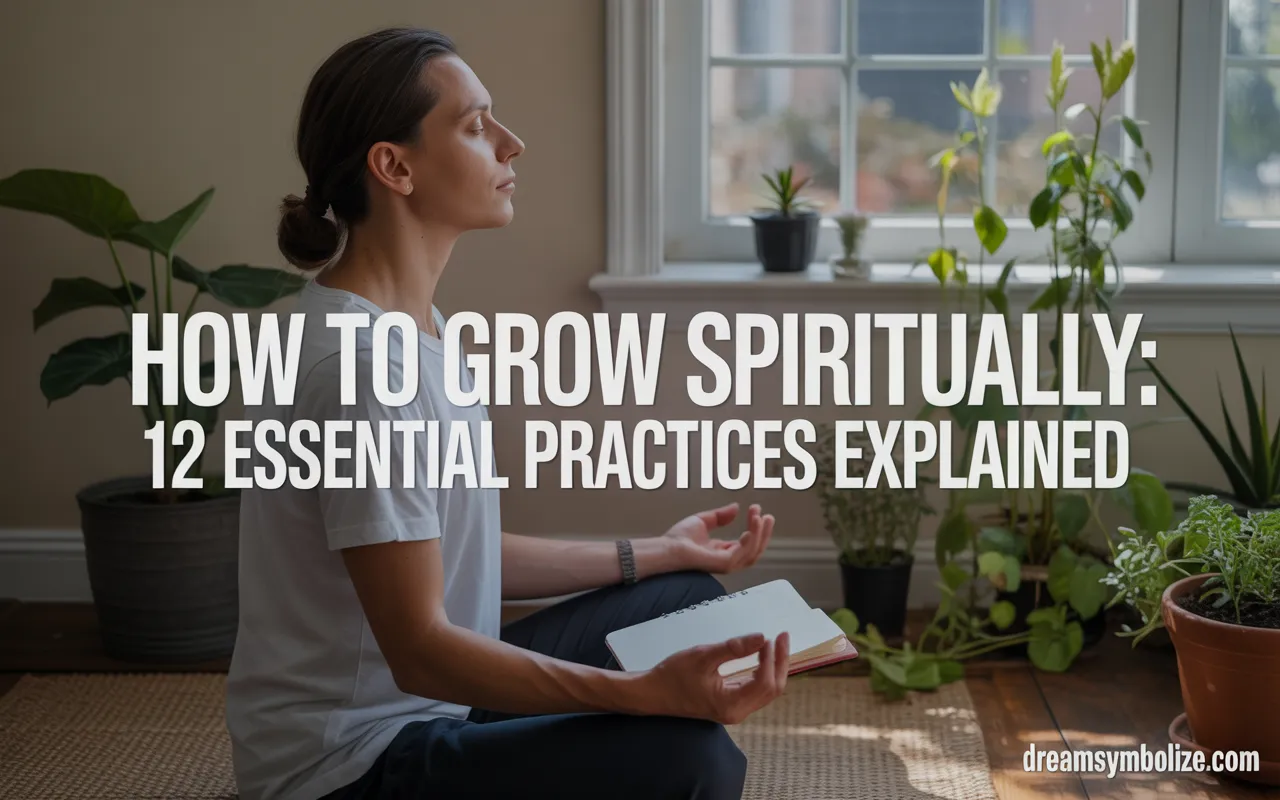
The desire for growth is a fundamental part of being human. We strive to advance in our careers, improve our health, and deepen our relationships. Yet, there’s another form of growth that often gets overlooked—the quiet, internal process of spiritual evolution. It’s a journey not of doing more, but of becoming more.
You might feel a subtle pull toward this path, a sense that there’s a deeper, more meaningful way to live. But the question quickly becomes: how? How do you actually grow spiritually? It can seem like a vague and mysterious concept, reserved for ancient sages or monks in secluded monasteries.
The truth is, spiritual growth is a practical, accessible journey available to everyone. It doesn’t require you to abandon your life and retreat from the world. Instead, it involves integrating specific, intentional practices into your daily routine that help you connect with your authentic self, cultivate inner peace, and live with a greater sense of purpose.
This guide will demystify the process. We will explore 12 essential practices that serve as the foundation for a rich and transformative inner life. Think of these not as rigid rules, but as invitations—tools you can use to build a more conscious, compassionate, and connected relationship with yourself and the world around you.
Understanding the Foundation of Spiritual Growth
Before diving into the practices, it’s helpful to understand what we’re aiming for. Spiritual growth is the process of expanding your consciousness beyond the limited identity of the ego—the part of you that is defined by your name, your job, your history, and your fears. It’s the journey of moving from a state of separation and fear to one of connection and love.
This isn’t about becoming perfect or eliminating all negative emotions. It’s about developing the capacity to navigate all of life’s experiences with greater wisdom, resilience, and grace. The goal is not to escape your humanity, but to embrace it more fully.
These 12 practices are the “how-to” of that process. They are the tangible actions you can take to create the fertile ground from which your spirit can blossom.
The 12 Essential Practices for Spiritual Growth
Embark on this journey with curiosity and self-compassion. You don’t need to master all these practices at once. Start with one or two that resonate most with you, and build from there. The key is consistency, not intensity.
1. The Practice of Daily Stillness (Meditation)
In a world that constantly bombards us with information and demands our attention, stillness is a radical act. Meditation is the formal practice of cultivating that stillness. It is the single most powerful tool for spiritual growth because it trains you to do one crucial thing: observe your mind without being controlled by it.
Why it works: Most of our suffering comes from being lost in our thoughts—worrying about the future, ruminating on the past, or judging ourselves in the present. Meditation creates a space between you (the observer) and your thoughts. In that space, you find peace, clarity, and the freedom to choose your response to life.
How to practice:
- Start Small: Don’t try to meditate for an hour on your first day. Start with just 5 minutes. Consistency is far more important than duration.
- Find a Quiet Spot: Sit in a comfortable position where you won’t be disturbed. You can sit on a chair with your feet on the floor or on a cushion on the ground.
- Focus on Your Breath: Close your eyes and bring your attention to the sensation of your breath. Feel the air move in through your nose and out through your mouth. This is your anchor.
- Gently Return: Your mind will wander. That is what minds do. When you notice your thoughts have drifted, gently and without judgment, guide your attention back to your breath. Every time you do this, you are strengthening your “awareness muscle.”
2. The Practice of Self-Inquiry (Journaling)
If meditation is about quieting the mind, journaling is about exploring it. It is a practice of radical self-inquiry, a way to have an honest conversation with yourself on paper. A journal is a safe space to untangle your thoughts, process your emotions, and connect with your inner wisdom.
Why it works: Our minds are often a chaotic whirlwind of unprocessed feelings and half-baked ideas. Writing them down externalizes them, allowing you to see your own patterns with greater clarity. It helps you move from being a victim of your feelings to being a curious observer of them.
How to practice:
- Forget the Rules: You don’t have to be a “writer.” Forget grammar and punctuation. Your journal is for you alone.
- Free Writing: Set a timer for 10-15 minutes and write whatever comes to mind without stopping. Don’t censor or edit yourself.
- Use Prompts: If you feel stuck, use guiding questions. Some powerful prompts include: What am I truly feeling right now? What am I grateful for? What is a belief I hold that might be limiting me?
- Record Insights: Use your journal to track synchronicities, document insights from your meditation, or write down meaningful dreams.

3. The Practice of Mindful Presence
Spirituality is not something you do for 10 minutes a day; it’s a quality of presence you can bring to every moment. Mindfulness is the practice of paying attention to the present moment, on purpose and without judgment. It’s about bringing your full awareness to ordinary activities.
Why it works: Most of our lives are lived on autopilot. We eat without tasting, walk without feeling our feet on the ground, and listen without truly hearing. Mindfulness brings you back into your life. It anchors you in the “now,” which is the only place where true peace and joy can be found.
How to practice:
- Mindful Eating: At your next meal, put away your phone. Notice the colors, textures, and smells of your food. Chew slowly and savor each bite.
- Mindful Chores: When washing the dishes, feel the warmth of the water on your hands. Hear the sound of the plates. Turn a mundane task into a meditative practice.
- The Mindful Pause: Several times a day, simply pause. Take one conscious breath. Notice what you see, what you hear, and what you feel in your body. This simple act can reset your entire nervous system.
4. The Practice of Deep Nature Connection
Humans are not separate from nature; we are nature. For millennia, our ancestors lived in deep communion with the earth. Re-establishing this connection is a powerful way to ground your energy, quiet your ego, and remember that you are part of something vast and beautiful.
Why it works: Nature operates at a frequency of harmony and balance. Spending time in natural environments helps to recalibrate our own frenetic energy. The awe inspired by a majestic tree or a starry sky instantly pulls you out of your small, self-centered concerns.
How to practice:
- Leave Your Phone Behind: Take a walk in a park, forest, or on a beach without any electronic devices.
- Engage Your Senses: What do you see? What do you hear? What do you smell? Feel the wind on your skin. Touch the bark of a tree.
- Barefoot Grounding: If possible, take off your shoes and walk barefoot on grass, dirt, or sand. This practice, known as “earthing,” can have a profound calming effect.
- Bring Nature Indoors: If you live in a city, bring plants into your home. Tending to them can be a spiritual practice in itself.

5. The Practice of Shadow Work
True spiritual growth isn’t just about love and light. It’s about having the courage to look at your “shadow”—the parts of yourself that you have judged, repressed, and denied. This includes your anger, jealousy, shame, fear, and greed.
Why it works: The energy we use to suppress these parts of ourselves is immense. When we bring them into the light of our awareness with compassion, we reclaim that energy. Integrating the shadow doesn’t mean acting out your worst impulses; it means acknowledging them so they no longer control you from the subconscious.
How to practice:
- Notice Your Triggers: When someone or something makes you intensely angry or upset, it’s often because they are mirroring a disowned part of your own shadow. Get curious instead of blaming.
- Journal on Your “Dark” Side: Write about a time you felt deep jealousy or shame. Explore it without judgment. What was that part of you trying to protect? What did it need?
- Compassionate Inquiry: When a “negative” emotion arises, instead of pushing it away, turn toward it. Say, “I see you, anger. Thank you for trying to protect me. What do you have to teach me?”
6. The Practice of Gratitude
Gratitude is one of the fastest and most effective ways to shift your state of consciousness. It trains your brain to scan for what is good and abundant in your life, rather than focusing on what is lacking or wrong.
Why it works: The human brain has a natural “negativity bias” that causes it to fixate on threats and problems. A gratitude practice consciously rewires this tendency. It moves you from a state of lack to a state of appreciation, which is a much higher energetic frequency.
How to practice:
- Keep a Gratitude Journal: Each evening, write down three specific things you were grateful for that day. Be specific. Not just “my family,” but “the way my child laughed during dinner.”
- Express Your Gratitude: Don’t just feel it, share it. Write a letter to someone who has made a difference in your life. Tell a colleague you appreciate their work.
- Gratitude for Challenges: This is an advanced practice. Can you find the gift or lesson in a difficult situation? What did it teach you? How did it make you stronger?
7. The Practice of Conscious Movement
Your body is not just a vehicle for your brain; it is an incredible source of wisdom and a vessel for spiritual energy. A conscious movement practice helps you release stored tension, connect with your body’s intelligence, and embody your spiritual growth.
Why it works: Trauma, stress, and repressed emotions get stored in the body’s tissues. Practices like yoga, qigong, and tai chi are designed to release these blockages, allowing life force energy (prana or qi) to flow freely. They are essentially meditations in motion.
How to practice:
- Yoga: Explore different styles to find one that suits you. A gentle hatha or restorative class is a great place to start.
- Qigong or Tai Chi: These ancient Chinese arts involve slow, flowing movements that cultivate and balance your life energy. Many free classes are available online.
- Ecstatic Dance: Put on music you love and move your body freely without any choreography or judgment. Let your body express itself.
8. The Practice of Letting Go (Forgiveness)
Holding onto resentment, grievances, and old hurts is one of the biggest blocks to spiritual growth. It’s like carrying a heavy backpack full of rocks everywhere you go. Forgiveness is the act of putting that backpack down.
Why it works: Forgiveness is not about condoning what the other person did. It is an act of self-love. It is a decision to no longer allow a past event to drain your present energy. It cuts the energetic cord that binds you to pain.
How to practice:
- Write a Forgiveness Letter (Don’t Send It): Write a letter to the person you need to forgive. Pour out all your anger, pain, and sadness. At the end, write, “I forgive you, not for you, but for me. I release this burden.” Then safely burn or destroy the letter.
- Forgive Yourself: We are often our own harshest critics. Make a list of things you need to forgive yourself for. Read them aloud and say, “I did the best I could with the awareness I had at the time. I forgive myself.”
- Ho’oponopono: This is a simple but profound Hawaiian practice of reconciliation. Repeat the four phrases: “I’m sorry. Please forgive me. Thank you. I love you.”
9. The Practice of Mindful Consumption
Everything you take in—food, media, conversations—affects your energetic and spiritual state. Spiritual growth requires you to become a conscious gatekeeper of what you allow into your mind, body, and soul.
Why it works: Just as junk food makes your body feel sluggish, “junk media” (like constant bad news, violent movies, or celebrity gossip) clutters your mind and lowers your vibration. Consuming consciously helps you maintain a clear and peaceful inner environment.
How to practice:
- Media Diet: Be intentional about your media consumption. Unfollow social media accounts that make you feel bad. Limit your exposure to the news. Choose uplifting books, music, and movies.
- Conscious Eating: Pay attention to how different foods make you feel. Eat more whole, unprocessed foods that nourish your body.
- Guard Your Conversations: Notice how you feel after talking to different people. Limit your time with those who are constantly negative or draining. Seek out conversations that are inspiring and supportive.
10. The Practice of Service (Seva)
A spiritual journey that begins with a focus on the self ultimately leads to a focus on others. As you connect with your own essence, you realize your deep interconnection with all beings. The natural outcome is a desire to be of service.
Why it works: The ego is self-centered. The act of service immediately pulls you out of your own small world and its problems. It is a direct antidote to the ego’s narrative of separation. It is an expression of the love and unity you are discovering within.
How to practice:
- Random Acts of Kindness: Pay for the coffee of the person behind you in line. Give a genuine compliment to a stranger.
- Volunteer: Find a cause you care about and donate your time.
- Serve Through Your Work: Bring more presence, integrity, and kindness to your job. See your work as a way to contribute to the world.
- Listen Deeply: One of the greatest acts of service is to offer someone your full, undivided, compassionate attention.

11. The Practice of Study and Contemplation
While spiritual growth is an experiential journey, it can be profoundly supported by the wisdom of those who have walked the path before you. Studying spiritual texts and contemplating deep questions nourishes your mind and provides context for your experiences.
Why it works: Spiritual texts act as maps, offering guidance and reassurance. Contemplation helps you integrate this wisdom, moving it from intellectual knowledge to embodied understanding.
How to practice:
- Read Widely: Explore the core texts of different traditions—the Tao Te Ching, the Bhagavad Gita, the teachings of the Buddha, the works of mystics like Rumi or Meister Eckhart.
- Study Modern Teachers: Read the works of contemporary spiritual teachers like Eckhart Tolle, Tara Brach, or Michael Singer.
- Contemplate Big Questions: Spend time pondering questions like: What is consciousness? What is freedom? What is love? Don’t look for a quick answer. Let the question live inside you.
12. The Practice of Finding a Community
While your journey is uniquely yours, you don’t have to walk it alone. Connecting with like-minded individuals provides support, inspiration, and a sense of belonging.
Why it works: A healthy spiritual community (or “sangha”) acts as a mirror, reflecting both your light and your shadow. It provides encouragement when you feel lost and challenges you to grow beyond your comfort zone.
How to practice:
- Join a Meditation or Yoga Group: This is a natural way to meet people on a similar path.
- Find a Book Club: Start or join a club that discusses spiritual or philosophical books.
- Seek Online Communities: There are many online forums and groups dedicated to spiritual growth.
- Nurture Deep Friendships: Cultivate relationships where you can have honest, vulnerable conversations about your inner life.
A Lifelong Journey of Unfolding
Learning how to grow spiritually is not a project with a finish line. It is a lifelong practice of returning, again and again, to the present moment, to your heart, and to your true nature.
Be patient and kind with yourself. Some days you will feel expansive and connected; other days you will feel lost and contracted. All of it is part of the beautiful, messy, and profoundly rewarding process of inner evolution. Start with one small practice today, and trust that the path will unfold before you, one conscious step at a time.